
- calendar_today August 14, 2025
.
Electric Vehicle (EV) adoption in the United States is running into new headwinds as sales soften and infrastructure issues emerge. After over a year of month-over-month increases, electric car sales are now on the decline. Automakers like Genesis and Volvo have already turned away buyers from their electric cars, with both companies reassessing their EV lineups in the wake of poor sales.
The political situation is not helping, either. The Biden administration has slashed subsidies and vehicle pollution regulations, leaving fewer federal incentives for buyers to choose an electric car. But as industry analysts note, EVs may face the biggest roadblock not from the government but from underutilized garages in the average American home.
Charge Near Your Car
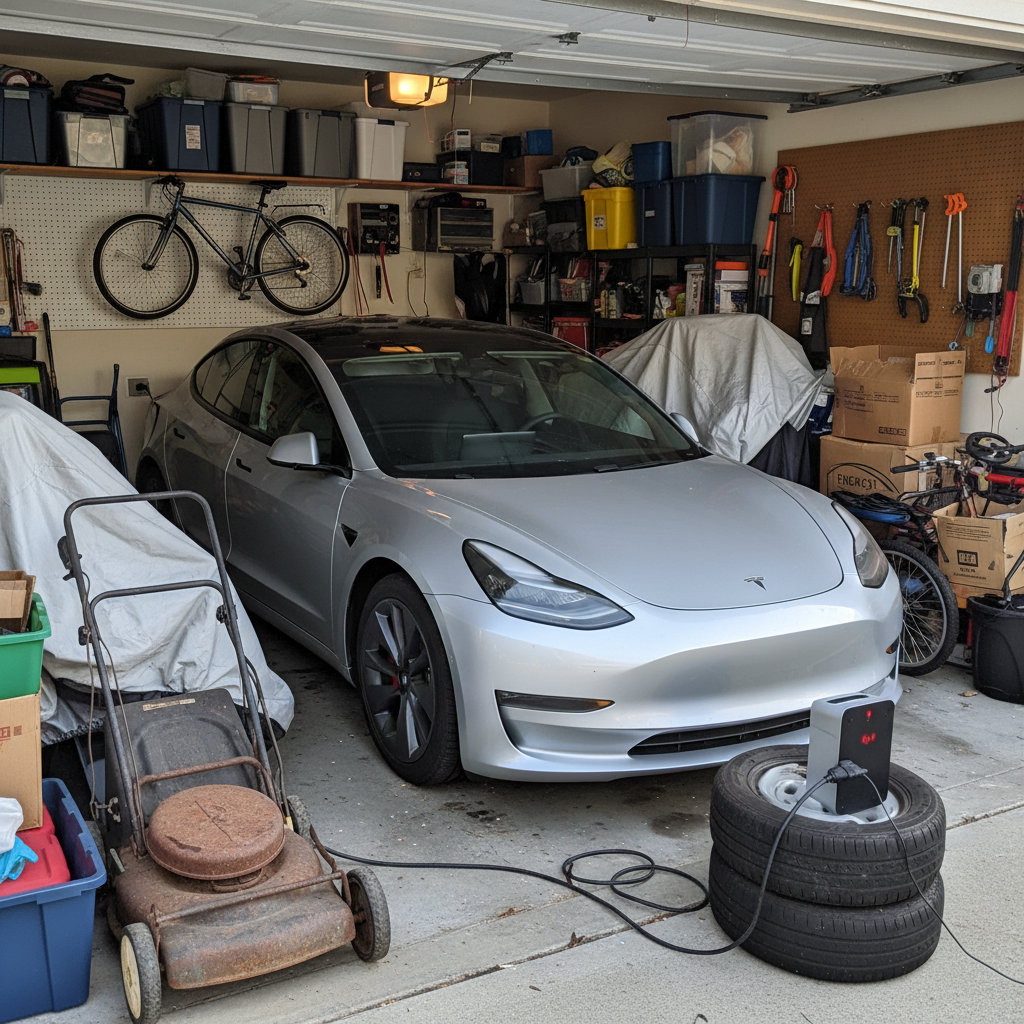
Polls and surveys have found for some time that charging remains the single biggest deterrent to EV adoption. A recent report from Telemetry Vice President Sam Abuelsamid offers a more nuanced look at the question, citing a rarely discussed issue at the heart of the problem: underused garages.
Fast chargers get most of the attention, but the majority of EV charging will still take place at home. Telemetry estimates that 80 percent of all EV charging in the U.S. uses AC power, most at a single-family residence. NREL found that 42 percent of homeowners already have access to an outlet capable of supporting level 2 (240-volt) charging near their parking spot.
This figure could increase dramatically, to 68 percent, if homeowners emptied space in their garages and changed their parking habits. “90 percent of all houses can add a 240 V outlet near where cars could be parked. Parking behavior, namely whether homeowners use a private garage for parking or storage, will likely become a key factor in EV adoption,” writes Abuelsamid.
This would increase the number of EV-ready homes from 31 million to more than 50 million. Including homes where wiring a new level 2 charger is possible, this number could rise to over 72 million homes. That would exceed Telemetry’s own higher forecast for EV penetration by 2035 of 33 million to 57 million vehicles.
Paper capacity doesn’t always translate to on-the-ground reality, however. The NREL study also found that nearly 34 million American homes would require a costly electrical upgrade to support a level 2 charger, which often requires a minimum of 30 amps of power. These upgrades, which can range from new wiring to full panel replacements, can cost several thousand dollars.
This also puts a dent in the narrative that electric cars are cheaper to own over time. Adding in the cost of charger installation, the total cost of ownership for a typical EV begins to approach or even surpass the cost of a gasoline-powered car.
Multifamily Dwellings Face Even More Struggles
Garages are not the only issue: the 23 percent of Americans who live in multifamily residences such as apartments, condos, or townhomes face even bigger barriers to EV adoption. In these homes, individual EV drivers rarely have the right to install chargers without the consent of their landlords, property management companies, or condo boards—permission that is not always forthcoming.
The financial barrier is also higher. For a co-op or similar multifamily dwelling, installing a pair of shared level 2 chargers may require an entire electrical panel upgrade as a first step, a multi-million-dollar project. Wiring individual spots at distant parking spots is an added expense. Unlike homeowners, these residents are less likely to qualify for municipal or utility subsidies to help with charger installation.
The result is that while about 1 million EV drivers currently live in multifamily housing, only 11 percent of them park within range of an outlet to charge their car. As part of its equity goals, the Biden administration has called for utilities to ensure that 20 percent of parking spaces in new homes be EV-ready. That will help, but even if all these targets are met, Telemetry forecasts that multifamily housing will still only have 6.7 million to 11.4 million charging-capable spaces by 2035. That falls far short of the total demand for such spaces.
Public Charging Infrastructure Must Fill The Gap
The limits of home charging solutions make public infrastructure an even more critical component of EV growth. Telemetry projects that 11.7 million to 14.3 million EV drivers who live in houses will still need to use public chargers by 2035, along with another 7.8 million to 8.1 million EV owners living in multifamily housing.
Delivering on this demand would require between 523,000 and 586,000 DC fast chargers, plus another 1.5 million to 1.6 million level 2 chargers nationally. The challenge for power companies is that the grid is already under pressure, with large new AI data center sites competing for generation and distribution capacity. While there are multiple pilot programs for charging site installation, many have not been proven at scale.
Even if the EV advocates’ rosy projections are accurate, many barriers to the rapid U.S. adoption of electric vehicles remain. Millions of American homes have the potential for EV charging, but garage clutter, high costs for electrical upgrades, and the unique challenges of multifamily living threaten to hold back demand. Even with public charger rollout at scale, the resulting infrastructure may not be able to keep pace with demand over the next decade.
One thing is certain: as with so much of American EV adoption, the future of electric vehicles may rest as much in the nation’s garages as in the executive offices of the government.


