- calendar_today August 20, 2025
A research team from Carnegie Mellon University introduced LegoGPT, which is an advanced AI capable of producing stable Lego structures from basic text descriptions. The system produces Lego designs based on input text descriptions that can be built in reality through manual assembly or robotic systems. LegoGPT operates on the fundamental concept of translating written directives into sequences of brick positions that build structurally stable Lego constructions.
The Mechanics Behind Text-to-Lego Generation
LegoGPT operates through a technical foundation similar to the systems used by large language models such as ChatGPT. LegoGPT predicts where the next Lego brick should be placed instead of determining the next word in a sentence. Meta’s instruction-following language model LLaMA-3.2-1B-Instruct underwent fine-tuning by researchers to achieve their objectives. A specialized software tool improved this core model by validating design stability through mathematical simulations of gravitational forces and structural strength. LegoGPT’s training utilized the new “StableText2Lego” dataset, which contains over 47,000 physically sound Lego constructions and captions generated by OpenAI’s GPT-4o model. Rigorous physics analysis validated the real-world buildability of every structure in this dataset.
Creating models that can be physically constructed.
The digital 3D design field faces major challenges because digital models frequently fail to translate into physically constructible forms. Numerous current systems generate complex shapes but fail to ensure structural integrity for physical assembly since they include unsupported parts and unconnected segments. LegoGPT solves this problem by emphasizing physical integrity during the initial modeling stage. This new autonomous Lego modeling system stands apart from its predecessors because it creates Lego structures that come with sequential instructions to avoid structural failure. The project website offers various demonstrations to showcase LegoGPT’s capabilities.
The “Physics-Aware Rollback” for Reliable Construction
The “physics-aware rollback” mechanism is pivotal in maintaining LegoGPT’s output reliability. The system uses an intelligent mechanism to detect structural weaknesses during the design stage. When the AI detects that an aspect of the design would fail under realistic physical conditions, it will not terminate its process. The system intelligently backtracks when it detects a structural problem by removing the flawed brick and any following bricks before trying another configuration. Through an iterative process that simulates physical forces, LegoGPT enhances stability, which boosts the proportion of stable designs from 24 percent to 98.8 percent.
Real-World Validation Through Robotics and Human Testing
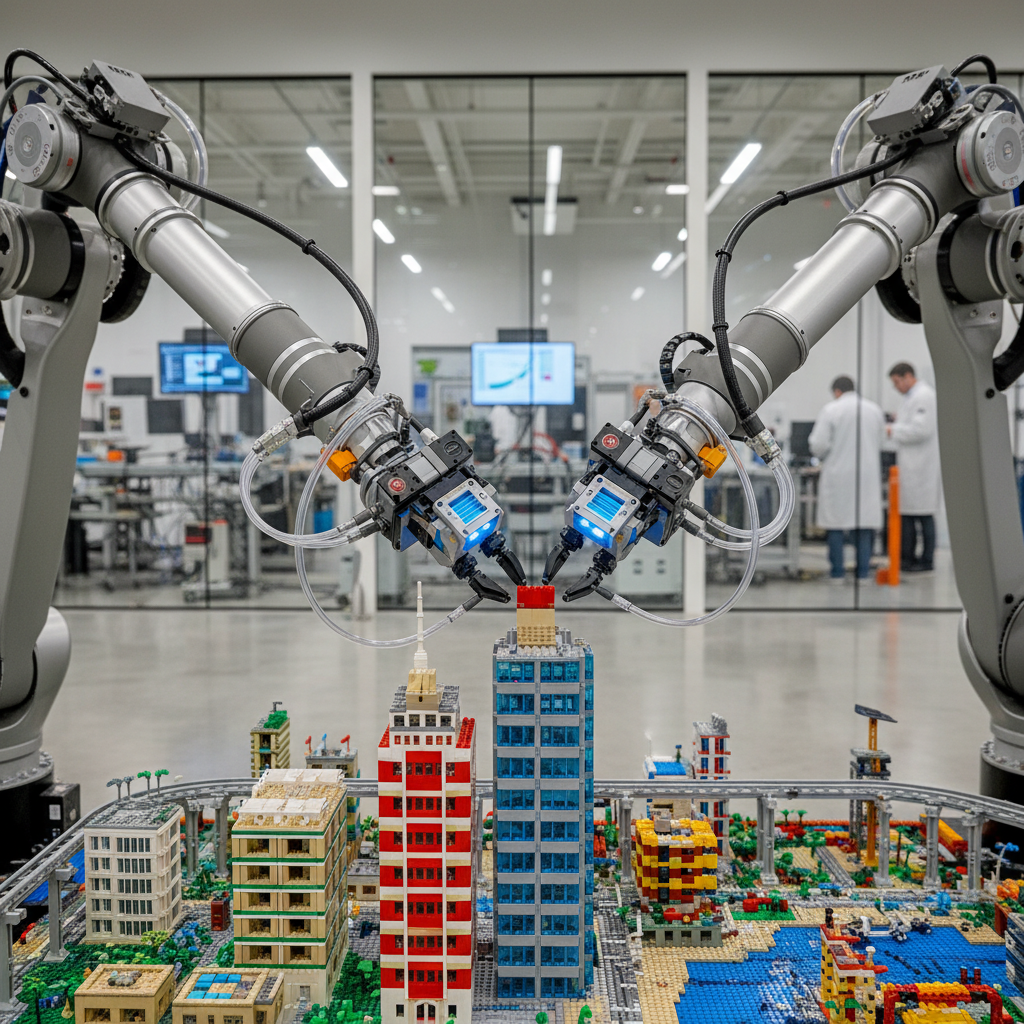
The research team validated the AI-generated designs by physically constructing the models. A dual-robot arm system with force sensors enabled researchers to accurately pick up and position bricks according to LegoGPT’s instructions. Human testers contributed to the validation process by manually assembling certain AI-created designs, which showed that LegoGPT generates structures that can be physically built. The research team documented how their experiments confirmed LegoGPT’s capability to create stable and aesthetically pleasing Lego designs that showed diversity while maintaining close adherence to initial text prompts.
Future Directions and Potential Impact
LegoGPT sets itself apart from other 3D creative AI systems, such as LLaMA-Mesh, due to its foundational focus on structural integrity. The present version of the system works within a 20×20×20 building space using eight standard brick types, but future developments will broaden the brick library to encompass various dimensions and brick types. LegoGPT demonstrates significant progress in merging artificial intelligence with physical creation by illustrating AI’s ability to connect digital designs with tangible products and extend its impact beyond toy design.