
- calendar_today August 10, 2025
From horned humans to hair sculptures: MJT’s treasures survive fire
The Museum of Jurassic Technology (MJT) is one of Los Angeles’s more unusual cultural institutions, but it now finds itself in a more conventional position: in need of repairs after a major fire. This past Sunday night, a fire was reported at MJT, and the blaze caused significant damage to the building as well as destroyed its gift shop. The blaze broke out around 11 30 PM on July 8, and though a response from firefighters was quick, the gift shop—which was located at the front of the building—was razed, and smoke damage affected multiple exhibits. Estimates for lost revenue while the museum is closed top $75,000. The Museum of Jurassic Technology is expected to reopen next month.
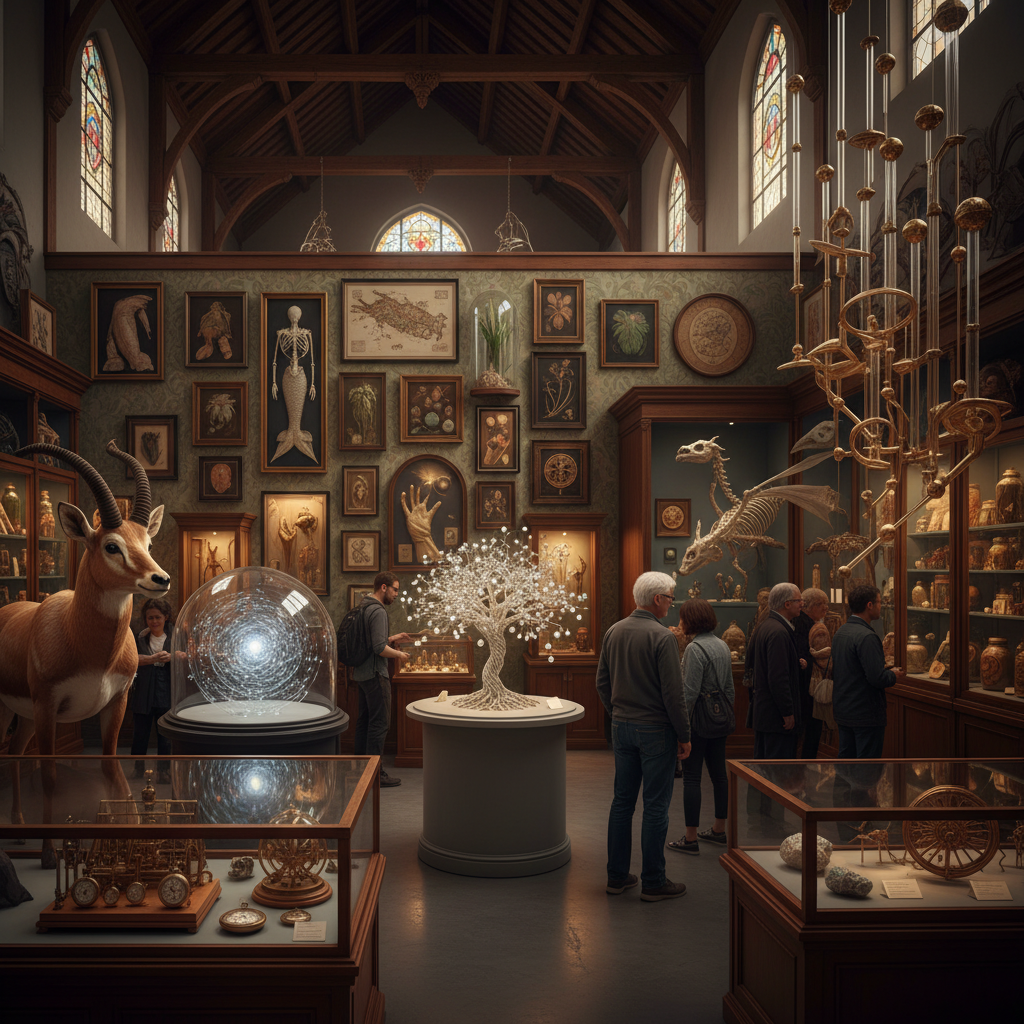
MJT, a fixture in LA’s Culver City neighborhood, has had a somewhat countercultural place in the city’s cultural history for a long time. Opened in 1988 by David Hildebrand Wilson and Diana Drake Wilson, the museum has for the past three decades specialized in exhibiting “curious and perplexing collections and displays.” While the museum’s signage proudly proclaims that the MJT is “dedicated to the advancement of knowledge and the public appreciation of the Lower Jurassic,” that is far from the truth. It has relatively little to do with the Jurassic period: rather, it was more or less inspired by cabinets of curiosity, or wunderkammers, from the Renaissance period, precursors to the modern museum.
In the years since, MJT has gained a name for itself as a deliberately odd but richly textured museum, offering up curious and sometimes unverified history with an unusual depth. It mixes fact and fiction in its exhibits and leaves many museum-goers unsure of what is true or not. While many of the displays and exhibits do present genuine historical documents and ephemera, others are of more questionable authenticity. One of the more well-known permanent exhibitions, for example, is an assemblage of objects celebrating the work of Athanasius Kircher, a 17th-century polymath and Jesuit priest who is known for his prodigious range of interests and talents. A similarly high-profile exhibit features the work of Hagop Sandaldjian, an Armenian-American sculptor whose life’s work consisted of hyper-detailed and highly rarefied sculptures so small that they’re placed inside the eye of a needle to be viewed. These sculptures are crafted out of a single human hair.
The museum has its fair share of strange exhibits, too. One case presents a collection of decomposing dice that once belonged to magician Ricky Jay, while another exhibit offers a visual survey of Los Angeles-area trailer parks, a project described as “The Garden of Eden on Wheels.” Stereographic radiographs of flowers, microscope mosaics made from the scales of butterfly wings, and a collection of “odd, heartbreaking, strangely stirring letters to the Mt. Wilson Observatory from amateur astronomers, composed between 1915 and 1935,” are among the other curiosities MJT has to offer. Since 2005, the museum has also housed a Russian tea room, patterned after the study of Czar Nicholas II in the Winter Palace in St. Petersburg, Russia.
The fire and the aftermath
As per a report on the fire published by author Lawrence Weschler, whose 1996 book Mr. Wilson’s Cabinet of Wonder goes into the detailed provenance of many of the MJT’s pieces, the blaze was first noticed by David Wilson himself, who lives in a residence behind the museum. Noticing the building in flames, he quickly made his way to the scene with two fire extinguishers in tow. A “ferocious column of flame” was how Wilson later described it, telling Weschler of how the fire was climbing up the corner wall of the building, the one that faces the street.
In his attempt to put out the fire, Wilson found that the extinguishers he had were too small to make any impact on the blaze. Thankfully, his daughter and son-in-law soon arrived at the scene with a larger fire extinguisher, which succeeded in dousing the flames shortly before firefighters arrived at the scene. The firefighters later told Wilson that had they arrived just a minute later, the entire building would have been destroyed.
Structurally, the main damage was confined to the gift shop area, but smoke had infiltrated much of the museum. Wilson described the sight as having “a thin creamy brown liquid… evenly poured over all the surfaces—the walls, the vitrines, the ceiling, the carpets, and eyepieces, everything.” Smoke damage of that severity can present a serious challenge, especially for a museum as detail-oriented as MJT. Since the fire, the museum has been working to clean and repair the damage, a process Wilson described as slow and painstaking. In the meantime, Weschler has encouraged donors to make contributions to the museum’s general fund to support the museum while it remains closed. “One of the most truly sublime institutions in the country,” Weschler wrote of MJT, is one of a kind in its combination of erudition, iconoclasm, and, simply, off-kilter strangeness.
MJT has not yet announced a specific reopening date, but is expected to open sometime next month.


