- calendar_today August 17, 2025
Is This the Least Marvel-Like Marvel Movie Yet?
Marvel’s The Fantastic Four: First Steps is a fun and flashy reboot of the comic-book publisher’s first superhero team. Visually, it’s a feast: a delightfully retro story from Marvel that knows what it is. The performances, particularly from Pedro Pascal and Ebon Moss-Bachrach as Reed Richards and Ben Grimm, are strong. But for all the solid cast and no-holds-barred 1960s-does-a-colour-colour homage, the film lacks any real buildup of suspense or urgency.
Marvel producer Kevin Feige’s description of the movie as “a no-homework-required” experience could not be more apt. In an era where Marvel movies’ first 20 minutes often include expositions on multiple multiverses, dozens of cameos, and general hand-wringing over spin-offs and other forms of IP management masquerading as plot, First Steps is a refreshingly straightforward MCU entry. It has none of the above. This Fantastic Four works in a self-contained bubble, reintroducing the characters of Reed Richards, Sue Storm, Johnny Storm, and Ben Grimm with no reference to the backstories or continuity of previous adaptations or incarnations. The movie takes a real sense of pleasure in simplicity—and, often to its detriment, little else.
The film begins with a talk show hosted by Mark Gatiss, whose interviewer character performs the service of providing a helpful voice-over recap of how these four became the Fantastic Four. Four years earlier, a space mission investigating cosmic energy exposed Reed, Sue, Johnny, and Ben to a form of radiation that changed their DNA. Reed, played thoughtfully and with quiet comic timing by Pascal, acquired the power to stretch his body like rubber. Vanessa Kirby’s Sue Storm can turn invisible and create force fields. Joseph Quinn’s Johnny has become the Human Torch, with the power to combust and fly. And Ebon Moss-Bachrach is Ben, whose body irreversibly changed into a towering, muscle-bound rock giant: The Thing.
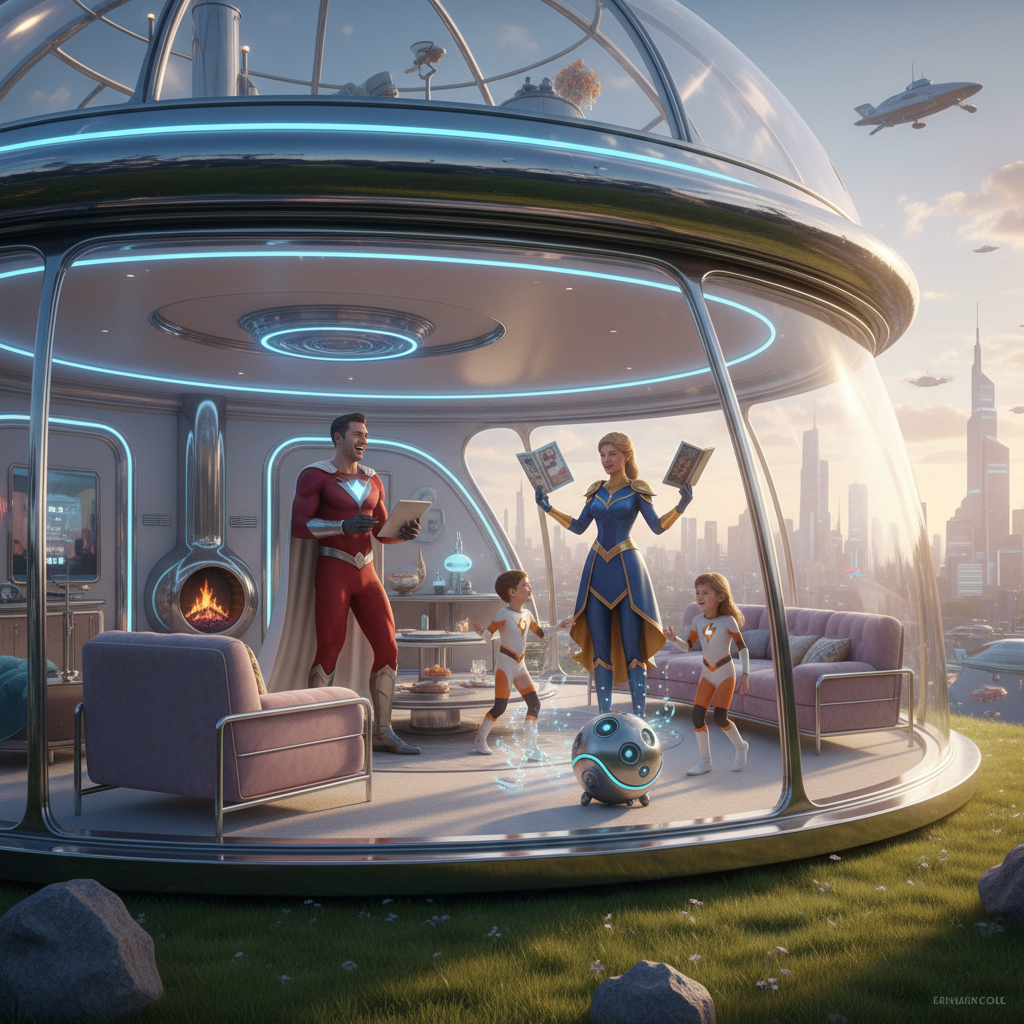
The four now live together in an idyllic domestic arrangement that appears to be, at least from the exterior, an atomic-age house that’s part space compound. It’s got flying cars, chalkboard equations decorating the walls, and a toddler-sized humanoid robot named H.E.R.B.I.E. who gets all the best lines as he helps around the house. First Steps’ worldbuilding is pure retro-futurism: square television screens with visible antennae, no cell phones, and an air of innocent enthusiasm as applied to design aesthetic. It’s a delightful time capsule of what comics imagined in the 1960s: a retro-futuristic trippy mashup of The Jetsons and Lost in Space with Marvel comics dropped on top.
The problem is that while this aesthetic is beguiling, the story never quite gains a sense of stakes or velocity. The central through-line in the story is family and the familial closeness of the four leads. Sue, we find out early in the film, is pregnant, to Reed’s anxious and largely adorable consternation. In one funny set-piece, Reed and Sue have a late-night conversation with H.E.R.B.I.E., in which Reed orders the small robot to baby-proof both the house and their makeshift science lab. Johnny and Ben flit around in the background, providing an older-younger brother dynamic of bickering and comic one-upping, but also very clearly welcoming their new roles as uncles.
Of course, in classic cosmic-comic book fashion, there’s always a galactic plot element that, for the sake of the world, these Marvel heroes must stop. Galactus, a giant armored humanoid with black-ridged glowing eyes and a vaguely Norse-fairy-tale aesthetic, is on a collision course with Earth with the express purpose of devouring the planet. It’s an ancient cosmic villain who prefers to arrive in person, meaning that before he gets there, his herald will visit and let the good (Fantastic) and the bad (average) know. This herald, or messenger, takes the form of a silver-skinned humanoid in motion-capture performance by Julia Garner. The Silver Surfer, as she is named, floats into the home of Reed and company with liquid menace. But before long, she’s been added to the house guest list (and firmly attached to the romantic fantasies of Johnny, a Fantastic Four-adjacent Peter Pan).
Oddly, the action of the film never really escalates in intensity. As Reed and the others chase Galactus through the void and dodge the Silver Surfer’s attacks, the violence and visuals remain in line with the retro-does-color palette: bursts of light, wisps of fire-trails, and cartoonish kabooms and kabonks of energy. Sue’s climactic labor while the team is out in space in a super-mobile van, the surreal twist on the expected final action set-piece in superhero movies, feels more trippy than tense. The cinematography and staging of the film often suggest a cosmic-scale birth story as much as the race to stop a planet-devouring monster.
If the lack of suspense or urgency in First Steps can be seen as a sin, it’s also somewhat of an odd pairing with the sincerity of the movie’s more emotional moments. For every heartfelt, watch-your-husband-be-a-dork-with-a-science-project moment, there’s an equal dose of silly pastel-colored antigravity stunts and FX wizardry. The film somehow never quite manages to make the latter feel like it has anything at stake, even as the end of the Earth looms.
The Fantastic Four: First Steps is an old-school Marvel adventure in the best sense: fun, stylish, and sweet. But it’s also a first step towards a broader MCU narrative, with light on action and heavy on nostalgia. It’s an interesting reintroduction to the mythos and characters, but other Marvel entries have brought out the bombast in a way that First Steps cannot quite muster. For those in the mood for an MCU film less concerned with being Marvel vs. Cap while the fate of the planet hangs in the balance, First Steps is the home run ride of your dreams. But if you’re looking for a thrill or something Marvel can sink its teeth into, this first entry may fall flat.